Roofing service in New Britain, CT
What roofing work on New Britain homes usually involves, and how to arrange it.
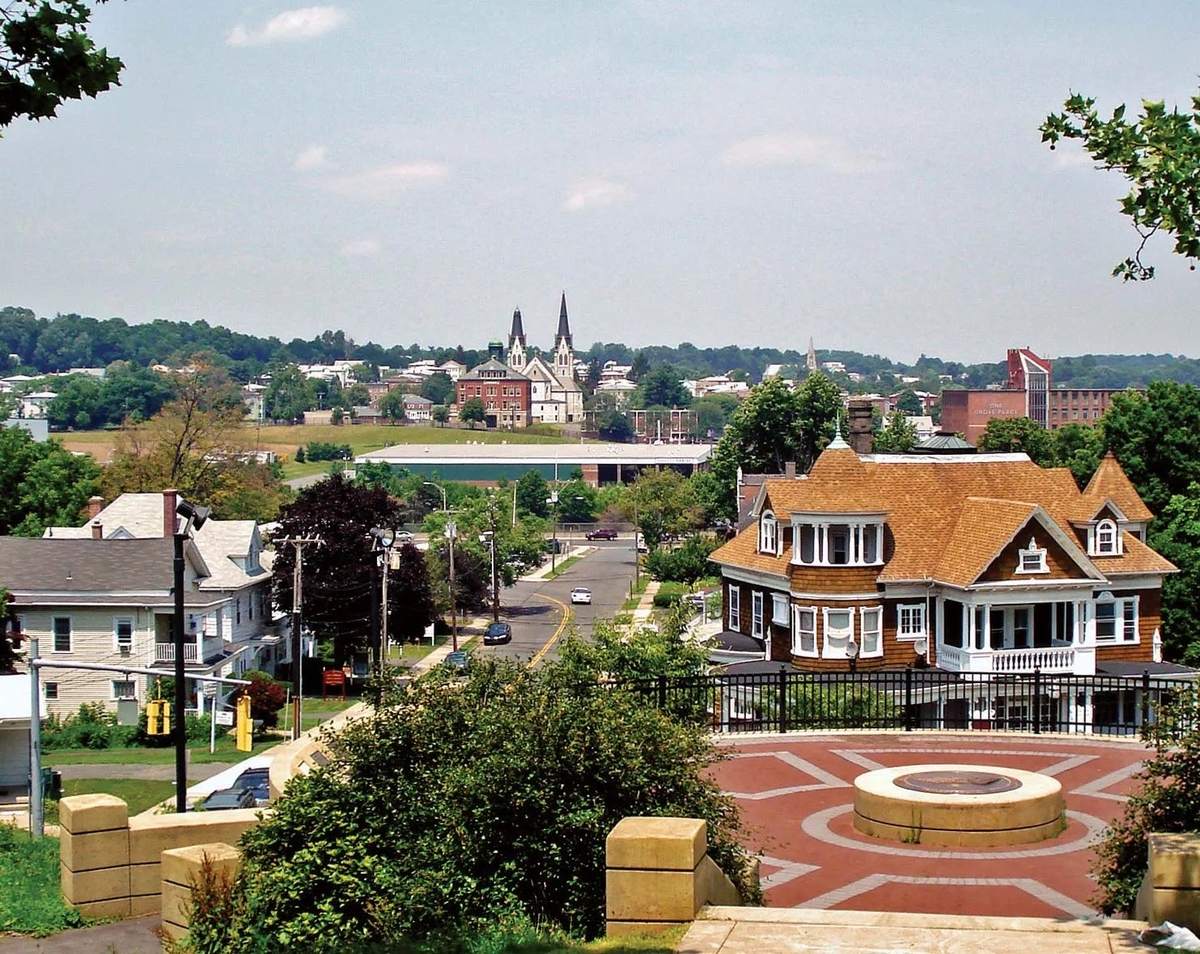
Covering New Britain
Roofing work in New Britain, CT
New Britain is a short drive from Hartford, and the crews, the materials, and the fixed-price quote are the same ones Hartford gets. Storm damage and active leaks take priority over scheduled work; replacements and inspections get booked around what's already on the schedule.
What the roofs are like in New Britain
New Britain has about 73,301 residents, the largest population among the towns in this ring, and a median household income near $57,036, the lowest of the group. Roughly 44 percent of homes are owner-occupied, which means most housing here is rental, a genuinely different pattern than most of the surrounding towns show. The median home was built around 1956 — close to Hartford's own median of 1953 — putting New Britain among the oldest housing stock in the area as well as the most rental-heavy.
None of these figures describe every single building in town, but together they describe the market as a whole clearly enough to shape which services actually matter most here.That combination — old, dense, and majority rental — shapes roofing priorities differently than it does in a town with a newer, more owner-occupied housing stock. A landlord managing an older multi-family building at New Britain's income level is optimizing hard for durability per dollar spent, not for a material that reads well on a real estate listing, and the roofing decisions that make sense here reflect that reality directly.
None of that means the work gets done any less carefully. It means the priorities are ordered differently: proven materials and correct installation over anything cosmetic, a repair scoped to actually solve the problem rather than defer it, and a level of documentation that holds up when a decision has to be justified to someone who isn't standing on the roof themselves.When a roof's pitch stops working for the building
Older multi-family buildings in a city like this one frequently carry additions, converted attic space, or porch roofs built at some point after the original construction, and those later additions do not always match the main roof's pitch. A section built too shallow for the shingle material covering it sheds water poorly, holds standing moisture longer than it should, and fails well before a properly pitched section of the same age and material would. Roof re-pitching corrects that mismatch directly, adjusting a problem section's slope so the roofing material on top of it can actually do the job it was designed for, rather than continuing to patch a section that's fighting its own geometry every time it rains.
This comes up more often on older, added-onto buildings than on newer construction, simply because a modern build gets its roof pitches specified correctly from the start, all at once, by a single design. An older building that has grown piecemeal over decades, sometimes under more than one owner, is more likely to have at least one section where an addition's roof was framed to a pitch that made sense for the addition's structure but not for the roofing material that eventually went on top of it.
For a landlord weighing the cost of re-pitching a problem section against repeatedly patching the same recurring leak, the math tends to favor the correction once the pattern is clear. A section that needs the same repair every year or two is not actually being fixed each time — it's being temporarily addressed, at a cost that adds up to more than the correction would have, spread out just slowly enough to not feel like it.
Identifying a mismatched pitch is usually straightforward from the roof itself, even if the underlying cause — an addition framed independently of the original structure, sometimes decades apart and by different builders — is less visible without checking the framing directly. Standing water after a rain, granule buildup in one low corner, or a section that always seems to need attention while the rest of the roof stays quiet are the practical signs that a pitch problem, not a material problem, is the actual cause.
Deferring a re-pitching correction has a cost beyond the recurring repair bill too. Standing water that sits against shingles or membrane for extended periods accelerates deterioration of the material itself, which means a section left unaddressed doesn't just keep needing the same patch — it tends to need a larger one each time, as the underlying material degrades faster than it would on a properly draining section of roof.
Getting that read early, before the damage compounds, is worth more here than the modest cost of checking it in the first place.
The material that shows up most on this kind of roof
Flat and low-slope sections are common on older, converted multi-family buildings — over additions, porches, and sometimes over the full structure on a building that was built or later modified with a flat roof. EPDM rubber roofing installation is one of the most common answers for that kind of section, and the reasons line up directly with what a landlord managing property at this income level is actually optimizing for: EPDM is a durable, relatively economical membrane material with a long service life and straightforward repair when something does go wrong, compared to more specialized or higher-cost flat-roofing systems.
Installation quality matters more than the material choice itself, though. A rubber membrane seamed and flashed correctly at every penetration and edge performs close to its full expected service life; the same material installed with rushed seaming or inadequate edge detailing fails well short of it, regardless of how good the membrane itself is. On a building where the roof is a cost center rather than a personal investment, getting the installation right the first time matters more, not less, than it would on a single-family home, because a failure means a repeat expense the owner's budget has to absorb on top of the original cost.
None of this means EPDM is the automatic answer for every flat section in town. It's simply the material that shows up most often in this kind of building stock because it fits the combination of durability, cost, and straightforward maintenance that a rental-property owner working with a tighter margin needs from a roof that has to perform reliably without becoming an ongoing expense.
EPDM's dark color is worth mentioning specifically, since it absorbs more solar heat than a lighter-colored membrane would, which affects both the roof's own temperature cycling and, to a lesser extent, the building's cooling load in summer. That tradeoff is generally accepted for this application because EPDM's durability and cost profile still outperform lighter-colored alternatives on a straightforward cost-per-year-of-service basis, even accounting for the added heat absorption — though a building owner weighing energy costs specifically alongside roof durability has reason to discuss that tradeoff directly before choosing a membrane color and product line.
Repair, when it's needed, tends to be more contained on an EPDM roof than on some alternative flat-roofing systems, since a properly seamed membrane repair can address a localized failure without requiring the whole surface to be redone. That repairability is part of the same cost logic that makes EPDM a common choice here in the first place — a landlord isn't just buying an initial installation cost, they're buying a material that stays reasonably cheap to maintain over its full service life, not just at the point of installation.
None of this rules out other membrane options for a specific situation. It simply explains why EPDM turns up so consistently across this particular kind of building stock, more than any single product being universally correct for every flat roof regardless of the building it's on.
Bringing an old roof's details up to current practice
A roof built around 1956 predates a number of details that are now standard, drip edge among them. Drip edge — the metal flashing that runs along a roof's eaves and rakes, directing water away from the fascia and roof deck edge rather than letting it wick back underneath — was not universally installed on residential construction at that time the way it is required or expected today. A roof from this era that has never had it added is more vulnerable to water working its way back under the shingle edge and into the fascia and deck than a roof with proper drip edge protecting that same vulnerable perimeter.
A roof drip edge installation is a relatively contained job compared to a full reroof, and it's exactly the kind of correction that makes sense to add whenever a roof is already being worked on for another reason — a re-pitching project, a repair near the eaves, any point where the roof edge is already exposed. Retrofitting it as a stand-alone project is possible too, but it's most efficient bundled with other work already underway on the same section of roof.
Across all three of these — re-pitching a mismatched section, choosing EPDM for a flat portion, adding drip edge where it's missing — the common thread is the same one that runs through New Britain's roofing needs generally: durable, code-correct work that holds up over time on a budget that has to be spent carefully, on buildings where the person paying for the roof and the person living under it are, more often than not here, two different people entirely.
None of this is a criticism of how these buildings were originally built. Drip edge simply was not standard residential practice everywhere at the time much of New Britain's housing stock went up, and bringing an older roof's details in line with what's expected today is ordinary, sensible upkeep rather than a correction of some past mistake.
The same logic applies to other small, easily bundled corrections that come up on a roof this age — a step-flashing detail that could use updating, a valley that would benefit from modern ice-and-water protection, a vent boot that's aged past its rated seal life. None of these individually justify tearing off a functional roof, but each is worth addressing whenever the roof is already open for another reason, which is generally the most cost-effective time to correct a detail that's been outdated for decades without ever having caused an active problem.
That habit of bundling small corrections into planned work, rather than treating each one as its own separate project, is a large part of what keeps an old roof functioning well past what its original construction alone would suggest.
Hours
Mon–Sat 7am–6pm
Calls are answered Mon–Sat 7am–6pm. Arrival windows are agreed on the call, and storm damage gets priority.
Call (860) 421-6068What we handle
Roofing services we bring to New Britain
-
Full new-roof installation on additions, new builds and full tear-offs.
See details → -
Complete removal and replacement of a worn or storm-damaged roof, from deck inspection through final cleanup.
See details → -
Section or full-roof shingle replacement matched to existing coursing so the repair doesn't stand out from the street.
See details → -
Replacing rotted or delaminated plywood decking discovered during a tear-off, before new shingles or underlayment go down.
See details → -
Reframing a low-slope or flat section to a working pitch so water sheds instead of pooling and leaking.
See details → -
Sistering rafters and reinforcing framing that has sagged under snow load or years of undersized original construction.
See details →
Where we go
Hartford and the surrounding towns
Hartford is the base; these are the neighboring communities our crews cover.
- West Hartford, CT
- East Hartford, CT
- Wethersfield, CT
- Newington, CT
- Bloomfield, CT
- Windsor, CT
- South Windsor, CT
- Rocky Hill, CT
- Manchester, CT
- New Britain, CT
- Glastonbury, CT
- Farmington, CT
- Avon, CT
- Simsbury, CT
- Berlin, CT
- Bristol, CT
Hiring in one of these towns?
A separate guide for each town on what to check before you sign with any roofing contractor there — license and insurance, written scope, and what the warranty actually covers.
Request a quote
Not an emergency? Send the details.
For anything urgent, calling is faster — the phone is answered Mon–Sat 7am–6pm. Use this for scheduled work: inspections, estimates, or a replacement you want priced.