Roofing contractor serving Portland, CT
What to ask a roofing contractor in Portland, CT, and what a written quote should itemize before any work starts.
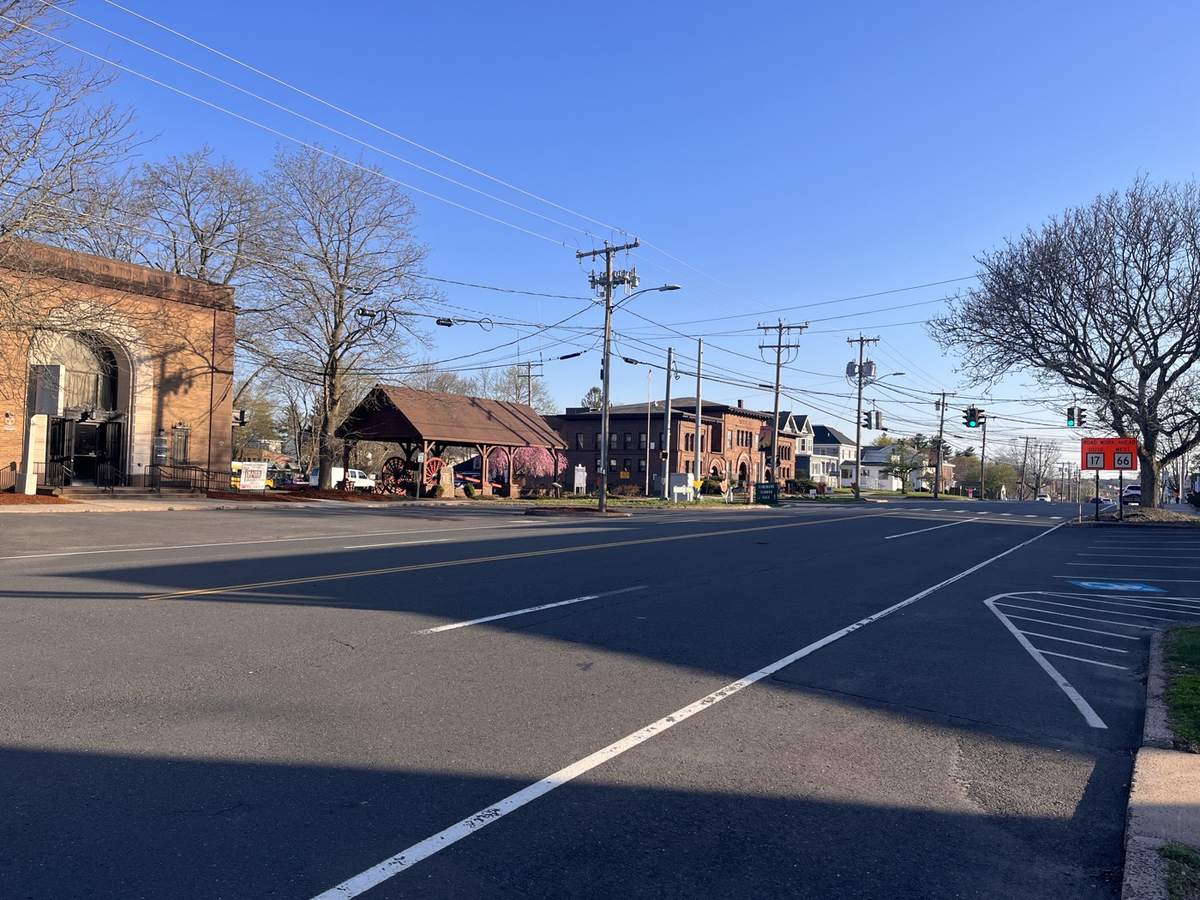
Hiring in Portland
Choosing a roofing contractor in Portland, CT
Whoever you hire in Portland should carry current license and insurance, put the scope in writing before a ladder goes up, and back the work with a warranty that survives the crew driving away. We run repair, replacement and storm-response jobs in Portland out of our Hartford base, quoted the same way for every town on the list.
What should actually happen during the estimate visit
A number produced from the driveway, without anyone actually getting on the roof, is a guess dressed up as an estimate. A proper roof inspection ahead of a quote means someone walks the roof itself, or at minimum gets close enough with a ladder to check flashing, penetrations, and any soft spots by hand rather than by eye from the ground. If the attic is accessible, a look from inside at the underside of the deck and the state of the insulation and ventilation adds real information a rooftop walk alone cannot.
It is fair to ask, directly, whether the person writing the quote is the person who will actually be on the roof for the estimate, or whether the number is coming from a sales visit with the technical inspection to follow separately. Neither approach is automatically wrong, but a homeowner is entitled to know which one is happening before deciding how much weight to put on the number that comes out of it.
Photos from the visit are worth asking for as well. A contractor who can show what they actually saw, rather than describing it secondhand, gives a homeowner something concrete to compare against a second or third estimate, and against the roof's actual condition once work begins.
It is also reasonable to ask how long the estimate visit itself typically runs. A thorough look at a full roof, its penetrations, and its attic access takes real time — a fifteen-minute visit that ends with a firm number is a sign the number is based on less information than a longer, more deliberate look would provide. This does not mean every quick visit produces a bad estimate, but a homeowner is entitled to know how much of the roof was actually examined, and by whom, before trusting the price that followed.
Skylights and other penetrations need their own scope line
A skylight is one of the more common places an otherwise sound roof develops a leak, since the flashing around it has to manage water on four sides of a hole cut through the deck rather than a simple straight run of shingles. If the house has one, the quote should say plainly whether the existing skylight and its flashing are being reused as-is, resealed, or replaced as part of the job, rather than leaving it unaddressed and assumed fine.
A roof skylight installation during a re-roof is often the more sensible time to replace an aging unit, since the roofing around it is already open and the labor to re-flash it is largely the same either way — waiting until the skylight fails on its own usually means paying for that labor twice. This is worth raising directly with a contractor rather than waiting to see if they bring it up, since a quote that never mentions the skylight at all may simply be treating it as someone else's problem.
The same logic applies to any other roof penetration — a plumbing vent, a chimney, an exhaust fan outlet. Each one is a place the roofing system has to be interrupted and resealed correctly, and a scope that lists them individually is telling a homeowner more than one that treats the whole roof as a single uniform surface.
None of this needs to turn a straightforward re-roof into a complicated negotiation. It simply means that a house with more penetrations than a plain rectangular roof deserves a quote that acknowledges each one by name, since the total price is ultimately built from those individual details rather than from square footage alone. Asking about each one directly, and getting a specific answer rather than a general reassurance that everything will be handled, is a reasonable part of any estimate visit on a house with more than a plain, unbroken roof plane.
Older construction and a small town's building stock
Portland has about 9,421 residents with roughly 82 percent owner-occupied housing, and a median home built around 1960 — older construction on average than much of the surrounding area, and old enough that a deck inspection allowance belongs in any quote as a real, priced item rather than an afterthought. Plank decking, older framing, and flashing installed under a different set of assumptions than current practice are common enough findings on a roof this age that a quote without room for any of it is probably underpricing the job.
A small town's housing stock also tends to include a wider mix of building types than the median figure alone suggests — a detached garage, a converted barn, an older porch roof — and any flat or low-slope section on a property like that needs its own conversation rather than being priced as an extension of the main shingle roof. A flat roof repair scope is worth asking about separately if any part of the property has one, since the materials, the failure points, and the labor involved are different enough from a sloped shingle roof that folding the two together in one number usually means one of them is being priced wrong.
Roughly 82 percent of housing in town is owner-occupied, among the higher owner-occupancy rates in this part of the state, which generally means the person collecting quotes is also the one who will live with the results for years rather than pass the decision on to a tenant. That is worth keeping in mind when deciding how much detail to press for in a quote — the cost of an ambiguous scope on a house this age tends to surface eventually, and it lands on the same homeowner who signed the original contract, not on whoever wrote the estimate.
What the written quote should itemize
Beyond the age- and structure-specific items, the baseline for a complete scope stays the same. It should state tear-off versus overlay, and how any deck repair is priced if it turns up — a per-sheet rate agreed in writing, not an open allowance. It should name the underlayment product and how far ice-and-water shield extends at the eaves and valleys, and it should call out flashing by location, chimney, skylight, sidewalls, rather than one general line covering all of it.
It should say whether existing ventilation is being balanced or left as found. Cleanup, a magnetic nail sweep, and who hauls away old material should be named, along with who pulls the permit. A payment schedule tied to completed stages, rather than full payment before work starts, protects both sides, and warranty terms — the manufacturer's material coverage and the contractor's own workmanship coverage, listed separately — belong in writing rather than promised verbally.
Fastening pattern belongs on the list too. Most shingle manufacturers specify a minimum number of fasteners per shingle and where on the shingle they need to land, and a crew moving quickly can drift from that spec without the difference being visible once the job is finished. It rarely matters until a warranty claim gets filed years later and denied over an installation detail nobody discussed at the estimate stage, which is exactly why it is worth a direct question up front.
Questions worth asking before you sign
Does a skylight replacement really need to happen during the re-roof? Not always, but it is worth pricing both ways and comparing, since re-flashing an old skylight now and replacing the unit itself later usually costs more in total labor than doing both at once.
How do I know if the contractor actually got on the roof? Ask directly, and ask for photos taken during the visit. A contractor who inspected the roof in person will usually have specific details to share — the condition of a particular valley, a soft spot near a vent — rather than a general description that could apply to any house.
Is a flat-roof section always more expensive to fix than a shingle roof? Not necessarily, but it is priced differently, by material and by square footage in a different way than shingles, so a quote that treats it as a simple add-on to the main roof is usually not pricing it accurately either way.
What if the house has no attic access to inspect from inside? That limits what a visual inspection can confirm, and it is fair to ask how the contractor is accounting for that gap in the quote rather than assuming the deck and ventilation are fine with no way to check.
Hours
Mon–Sat 7am–6pm
Calls are answered Mon–Sat 7am–6pm. Arrival windows are agreed on the call, and storm damage gets priority.
Call (860) 421-6068What we handle
Roofing services we bring to Portland
-
Full new-roof installation on additions, new builds and full tear-offs.
See details → -
Complete removal and replacement of a worn or storm-damaged roof, from deck inspection through final cleanup.
See details → -
Section or full-roof shingle replacement matched to existing coursing so the repair doesn't stand out from the street.
See details → -
Replacing rotted or delaminated plywood decking discovered during a tear-off, before new shingles or underlayment go down.
See details → -
Reframing a low-slope or flat section to a working pitch so water sheds instead of pooling and leaking.
See details → -
Sistering rafters and reinforcing framing that has sagged under snow load or years of undersized original construction.
See details →
Where we go
Hartford and the surrounding towns
Hartford is the base; these are the neighboring communities our crews cover.
- West Hartford, CT
- East Hartford, CT
- Wethersfield, CT
- Newington, CT
- Bloomfield, CT
- Windsor, CT
- South Windsor, CT
- Rocky Hill, CT
- Manchester, CT
- New Britain, CT
- Glastonbury, CT
- Farmington, CT
- Avon, CT
- Simsbury, CT
- Berlin, CT
- Bristol, CT
Hiring in one of these towns?
A separate guide for each town on what to check before you sign with any roofing contractor there — license and insurance, written scope, and what the warranty actually covers.
Request a quote
Not an emergency? Send the details.
For anything urgent, calling is faster — the phone is answered Mon–Sat 7am–6pm. Use this for scheduled work: inspections, estimates, or a replacement you want priced.