Roofing service in Farmington, CT
What roofing work on Farmington homes usually involves, and how to arrange it.
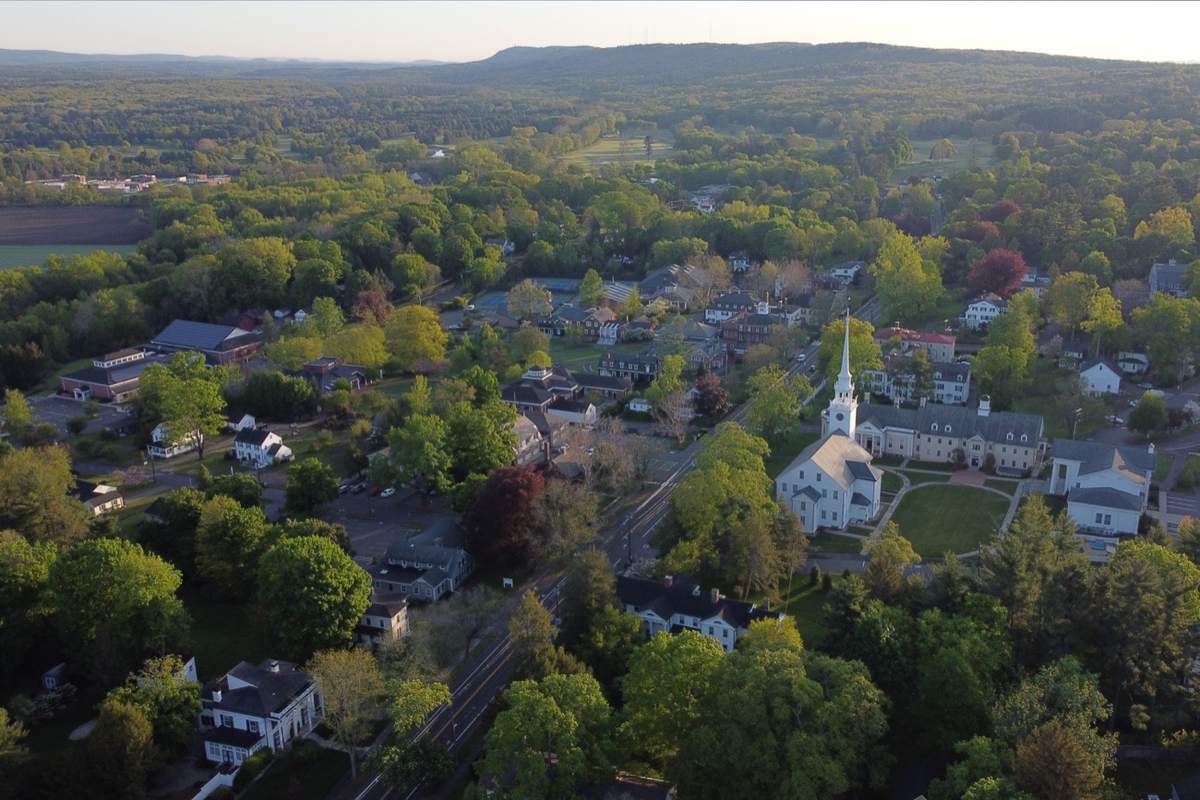
Covering Farmington
Roofing work in Farmington, CT
Farmington is a short drive from Hartford, and the crews, the materials, and the fixed-price quote are the same ones Hartford gets. Storm damage and active leaks take priority over scheduled work; replacements and inspections get booked around what's already on the schedule.
What the roofs are like in Farmington
Farmington has about 26,685 residents and a median household income near $134,237, with roughly 75 percent of homes owner-occupied and a median home built around 1980 — a roof that age is old enough to be generating its first real service calls but usually still young enough that those calls are about targeted attention, not full replacement — a meaningfully different situation than a town where the housing stock is older and multiple re-coverings deep.
That puts Farmington's housing stock nearly a generation newer than Hartford's own median of 1953, and the practical effect is a town where most roof conversations start from a position of relative confidence about the roof's underlying condition, rather than uncertainty about what decades of prior work may or may not have addressed correctly. Relative confidence is not the same as certainty, though — a roof this age can still develop a real problem, and the point of an assessment is finding out which situation actually applies rather than assuming the newer build year rules out anything worth checking. Either way, the answer comes from looking, not from the calendar.Why repair is usually the right first answer here
A roof reaching its first couple of decades of real service tends to develop specific, isolated problems rather than widespread failure — a flashing detail that's started to separate, a section of shingles that took more direct sun exposure than the rest of the roof and is wearing faster, a vent boot whose rubber collar has cracked with age while everything around it is still sound. A roof repair aimed at exactly that kind of isolated issue is the appropriate response on a roof this age, rather than treating every problem as a signal that the whole roof needs to come off.
That distinction matters because it's easy to over-scope a repair on a roof that still has most of its service life ahead of it. A homeowner or a contractor unfamiliar with the roof's actual condition can default to recommending replacement simply because that's the more straightforward sell, when the honest answer for a roof at Farmington's typical age is that a correctly diagnosed, well-executed repair addresses the actual problem without discarding years of remaining life in the rest of the roof.
Getting the diagnosis right the first time matters more here than it does on an older roof with a longer history of prior patches to sort through. A roof this age generally has a cleaner, more legible history — one covering, clearly documented if records exist, without decades of stacked repairs obscuring what's actually happening. That clarity makes an accurate repair scope more achievable, provided the person doing the assessment is actually looking for it rather than assuming the worst.
Cost is part of why getting this right matters. A repair correctly scoped to an isolated problem costs a fraction of a full replacement, and on a roof still well within its expected service life, that cost difference represents real, legitimate savings rather than a decision to defer an inevitable expense. The two situations look similar from a distance — someone found a problem, someone is fixing it — but the underlying economics are entirely different depending on how much service life the roof actually has left.
Sun exposure deserves specific mention because it's one of the more predictable ways a roof this age starts showing uneven wear. A south- or west-facing slope takes more direct UV exposure over the course of a year than a north-facing one on the same house, and that exposure difference compounds over two decades into a measurable difference in shingle condition between slopes that started out identical. A repair that recognizes this pattern — treating the more-exposed slope as its own consideration rather than assuming uniform wear across the whole roof — tends to produce a more accurate assessment than one that doesn't.
None of this is an argument against replacement when it's genuinely warranted. A roof with a real structural problem, or one that's simply past its material's expected life regardless of how it looks, needs replacement rather than a repair that only addresses the symptom. The point is that at Farmington's typical roof age, replacement is the exception rather than the default assumption, and treating it as the default costs homeowners money on roofs that had years of good service left.
That's the actual value an accurate diagnosis provides here — not a lower bill for its own sake, but a scope of work that matches what the roof genuinely needs at its current stage of life.
Adding a skylight to an already-established roof
A skylight added now to a house built around 1980 is a genuinely different project than the same work on a much older, multiply-recovered roof. Rather than working around an unknown patch history and uncertain deck condition, a roof skylight installation on a roof this age is typically cutting into a deck and covering with a clearer, more recent history — which makes it more straightforward to integrate the new opening cleanly, match flashing details to what's already there, and avoid disturbing more of the surrounding roof than necessary.
Matching matters more than homeowners sometimes expect. A skylight installed years after the original roof went on needs flashing and, ideally, shingle coloring that blends reasonably well with the surrounding material rather than reading as an obviously later addition. On a roof this age, that match is usually achievable, since the original materials haven't faded or weathered as dramatically as they would on a much older roof, and manufacturer product lines from a similar era are more likely to still be available or closely matched.
Warranty considerations are also worth raising directly before the work starts. Cutting into an existing roof covering can affect manufacturer warranty coverage on the surrounding material depending on how the work is done and documented, which is exactly the kind of detail worth confirming up front rather than discovering after the fact if a separate roofing issue comes up later and warranty coverage becomes relevant.
Structural verification still matters, even on a newer roof. Cutting an opening into any roof deck, regardless of the roof's age, changes how load and water move around that section, and a skylight has to be framed correctly on both counts — proper header framing to redirect structural load around the opening, and flashing detailed correctly to keep water moving around the penetration rather than toward it. A roof's relative youth makes the surrounding conditions more predictable, but it doesn't remove the need to get those specific details right.
Choosing where a skylight goes matters as much as how it's installed. A poorly placed skylight, positioned without regard for interior room layout or exterior roof geometry, can create both a less useful interior feature and a more awkward, leak-prone integration with the surrounding roof than a well-planned placement would. That's a design conversation as much as an installation one, and it's worth having before any cutting starts, not after the opening is already framed and the options have narrowed considerably.
None of this is meant to discourage adding a skylight to a house this age. It's meant to set expectations correctly: the work is more straightforward here than on an older roof, but that still means real planning, real structural consideration, and real attention to how the finished opening integrates with everything around it.
Getting that conversation right before work starts is what separates a well-integrated addition from one that reads as an afterthought.
A baseline inspection while the roof is still in good shape
A roof inspection on a roof already showing problems is a diagnostic tool. The same inspection on a roof that's still performing well serves a different purpose: establishing a documented baseline while there's nothing pressing to find, so that condition changes over the following years can be measured against an actual starting point rather than a guess about when problems began.
At Farmington's ownership rate, most of that decision sits with someone planning to be in the house for years, which is exactly the situation where a baseline inspection earns its value most clearly. A homeowner who knows the roof's actual condition today has a real reference point for judging whether a future concern represents meaningful new deterioration or is within the range of normal aging for a roof at that stage — a distinction that's much harder to make without ever having established what normal looked like in the first place.
A baseline inspection also produces something useful beyond the roof itself: a record that holds up whether it's referenced for a future repair conversation, an insurance question after a storm, or simply peace of mind for an owner who wants to know where things actually stand rather than guessing based on the roof's age alone.
Timing a baseline inspection doesn't require waiting for a specific trigger. Unlike an inspection prompted by a storm or a visible problem, a baseline check can happen whenever it's convenient for the homeowner, which is itself one of the advantages of doing it proactively rather than reactively — there's no urgency distorting the assessment, and no pressure to make a fast decision about anything found along the way.
What a baseline actually documents is worth being specific about: shingle condition slope by slope, flashing condition at every chimney, valley, and penetration, attic ventilation and any visible moisture signs, and overall structural observations where they're relevant. That level of detail is what separates a genuine baseline from a cursory walk-around that produces a vague sense of "looks fine" without anything concrete to measure future condition against.
None of this requires an alarming tone or a hard sell. A baseline inspection on a roof with nothing currently wrong should read exactly like what it is — a clean, factual account of good condition, worth having on file precisely because it costs little to establish now and becomes more valuable, not less, the longer it sits unused waiting for a future comparison.
Whatever the future need turns out to be, that record makes the eventual conversation shorter and more accurate than starting from nothing would.
That's the whole point of doing it before there's a reason to.
Hours
Mon–Sat 7am–6pm
Calls are answered Mon–Sat 7am–6pm. Arrival windows are agreed on the call, and storm damage gets priority.
Call (860) 421-6068What we handle
Roofing services we bring to Farmington
-
Full new-roof installation on additions, new builds and full tear-offs.
See details → -
Complete removal and replacement of a worn or storm-damaged roof, from deck inspection through final cleanup.
See details → -
Section or full-roof shingle replacement matched to existing coursing so the repair doesn't stand out from the street.
See details → -
Replacing rotted or delaminated plywood decking discovered during a tear-off, before new shingles or underlayment go down.
See details → -
Reframing a low-slope or flat section to a working pitch so water sheds instead of pooling and leaking.
See details → -
Sistering rafters and reinforcing framing that has sagged under snow load or years of undersized original construction.
See details →
Where we go
Hartford and the surrounding towns
Hartford is the base; these are the neighboring communities our crews cover.
- West Hartford, CT
- East Hartford, CT
- Wethersfield, CT
- Newington, CT
- Bloomfield, CT
- Windsor, CT
- South Windsor, CT
- Rocky Hill, CT
- Manchester, CT
- New Britain, CT
- Glastonbury, CT
- Farmington, CT
- Avon, CT
- Simsbury, CT
- Berlin, CT
- Bristol, CT
Hiring in one of these towns?
A separate guide for each town on what to check before you sign with any roofing contractor there — license and insurance, written scope, and what the warranty actually covers.
Request a quote
Not an emergency? Send the details.
For anything urgent, calling is faster — the phone is answered Mon–Sat 7am–6pm. Use this for scheduled work: inspections, estimates, or a replacement you want priced.